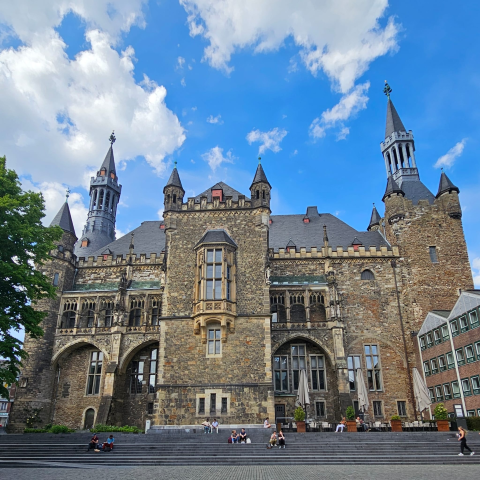
At WiPSCE 2026 in Aachen, our research lab presented three contributions (publications are still pending) addressing complementary challenges in K–12 computer science and AI education.
The full paper “Turning Students into Neurons – Evaluating an Embodied CS Unplugged Learning Activity on Neural Networks” by Lukas Lehner, Selina Reinhard, Martina Landman, and René Röpke reported on the evaluation of an embodied CS unplugged activity (“Seven Little Neurons”), where students enacted the behavior of neurons in a feedforward network through physical interaction. Based on a study with 78 participants, the results showed a significant increase in students’ self-assessed competence in “creating AI,” alongside strong motivational effects attributed to the embodied learning design, while also pointing to the need for further qualitative investigation. In the presentation at WiPSCE, Lukas presented our work and involved participants in a live demo of the unplugged neural network activity.
In addition, two posters were presented in interactive poster sessions:
- Michael Eickmeyer presented the poster “Improving Algorithmic Understanding via Path-finding Algorithms in Unplugged/Plugged Hybrid Workshops”, focusing on our upcoming workshop series combining unplugged activities with a gamified digital platform (“Dev0land”) to improve students’ understanding of path-finding algorithms and address persistent misconceptions. The paper is a collaboration with Oskar Seierl, Martina Landman, and René Röpke.
- Valentina Ferriaoli and Lukas Lehner presented the poster “Should We Open the Black Box? Investigating Transparency in K-12 Machine Learning Education”. The poster outlined a pilot study (N=66) examining how different levels of “glass-boxing” across the ML pipeline influence student understanding. The findings informed planned refinements of the intervention design. Together, the three contributions illustrated a consistent focus on making complex computing concepts accessible through targeted, research-driven instructional approaches.
As soon as the publications are available, references including DOIs will be provided.
Further details on the conference can be found here.